
How Much Weight Can a Plastic
Pallet Hold?
How much weight can a plastic pallet hold? Compare static, dynamic and racking loads, heavy-duty pallet capacities and CHSY-1210 specifications.
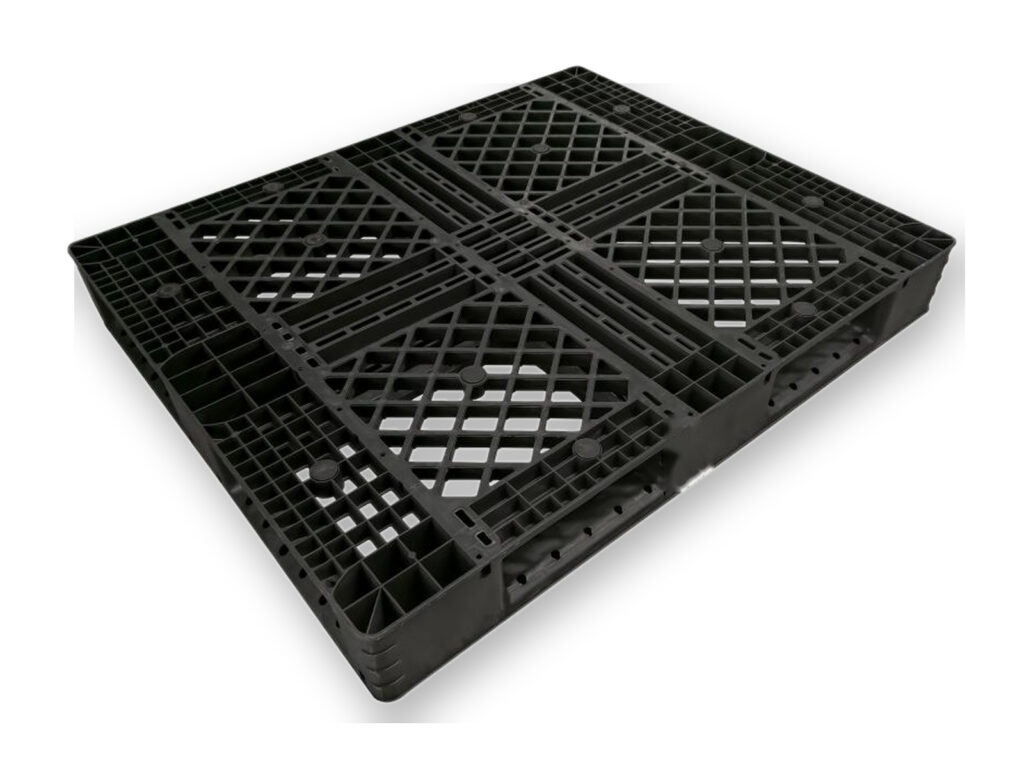
A practical guide to static, dynamic and racking load capacity
There is no single load rating that applies to every plastic pallet. A pallet resting on a level warehouse floor can usually support a greater load than the same pallet being moved by a forklift or stored on beam racking. The right specification depends on the pallet design, the way the goods are distributed and the conditions in which the pallet will be used.
As a broad guide, some light-duty plastic pallets have a dynamic rating of around 500 kg, while reinforced heavy-duty plastic pallets may be rated for dynamic loads of 2,000-2,500 kg. Static ratings can be several tonnes higher. These are indicative ranges, not guarantees: always check the rating for the exact model and application.
If the pallet will be placed on warehouse racking, use its rated racking load – not its static load. A high static capacity does not automatically mean that a pallet is safe for use on beams.
1. What do static, dynamic and racking load mean?
Plastic pallet suppliers commonly quote three different load ratings. They describe different support and handling conditions, so they should not be used interchangeably.
Static load capacity: the load a pallet can support while stationary on a firm, level floor, with the goods distributed as specified. This is often the largest of the three figures. If pallets are stacked, the permitted load and stacking arrangement must also be confirmed.
Dynamic load capacity: the load a pallet can carry while being moved by a forklift or pallet truck under the conditions defined by the manufacturer. Turning, braking, uneven floors, poor fork positioning and impact can all add stress.
Racking load capacity: the load a pallet can support when it is carried by a specified racking arrangement, such as beams, with part of its underside unsupported. Beam spacing, support points, pallet orientation and load distribution matter. A rackable plastic pallet should be approved for the actual system in which it will be used.
For many designs, the static rating is higher than the dynamic rating, and the racking rating is lower still. However, the ratings only make sense when their test conditions and definitions are known.
2. Typical plastic pallet load capacities
The table below summarises indicative figures for common pallet types. Capacity varies by dimensions, deck design, resin formulation, pallet weight, reinforcement and test conditions. Use the table to shortlist a design, then confirm the model-specific data with the manufacturer.
| Pallet type | Typical application | Static load | Dynamic load | Racking load |
|---|---|---|---|---|
|
Light-duty nine-leg pallet |
Parcel handling, e-commerce and one-way despatch |
1,000-1,500 kg |
Around 500 kg |
Generally not recommended |
|
Standard nine-leg or three-runner pallet |
Standard nine-leg or three-runner pallet |
Around 4,000 kg |
1,000-1,500 kg |
Around 800-1,000 kg, where reinforced and approved |
|
Blow-moulded double-sided or heavy-duty nine-leg pallet |
Heavy goods, bulk storage and industrial handling |
6,000-7,000 kg |
1,500-2,000 kg |
Around 1,000-1,500 kg |
|
Reinforced heavy-duty pallet with steel support |
High-bay storage, heavier loads and frequent handling |
Up to 8,000-10,000 kg |
2,000-2,500 kg |
Around 1,200-1,500 kg or more, depending on design |
IMPORTANT NOTE: These examples come online. They are not a substitute for current data sheets, load test reports or site-specific assessments of accurate pallet models. For accurate product data, please contact us.
The difference between pallet types can be substantial. A light-duty nine-leg pallet may be a sensible choice for light, floor-supported loads, but it is not automatically suitable for racking. For heavier goods or high-bay storage, a reinforced heavy-duty plastic pallet may be more appropriate – provided that its rack rating matches the warehouse system.
3. What affects a plastic pallet’s load capacity?
Pallet design and reinforcement
The deck, underside geometry, runners and support points all influence stiffness. Nine-leg designs can be economical and easy to handle, while three-runner, perimeter-base or double-sided designs may offer better support for particular applications. Steel reinforcement can improve racking performance on a model designed for it, but reinforcement does not make every pallet rackable.
Material and manufacturing consistency
High-density polyethylene (HDPE) is widely used for industrial plastic pallets because it combines toughness with resistance to moisture and many common handling stresses. Actual performance depends on the resin grade, additives, recycled content, moulding quality and quality control. Recycled-content plastic pallets are not automatically unsuitable for heavy loads, just as a pallet made from virgin resin is not automatically suitable for every application. Ask for model-specific load ratings and relevant test evidence.
Load distribution and goods being carried
Most published ratings assume a stated load pattern. A uniformly distributed load is different from a concentrated load placed in one corner or on a small area of the deck. Long, narrow or unevenly packed goods can create local stresses even when the total weight is below the headline rating. Keep the load stable, distribute it as evenly as practicable and follow any overhang limits.
Temperature, handling and service life
Cold conditions, repeated impacts, fork entry errors, dragging, sudden braking and long-term exposure to heat or ultraviolet light can affect performance. Inspect pallets regularly and take cracked, heavily distorted or otherwise damaged units out of service. A capacity rating should not be treated as permission to operate at the limit in every environment.
The racking system itself
A pallet and a racking installation work as one system. The beam span, bearing width, rack configuration and placement of the load must match the assumptions behind the pallet rating. Before introducing a new pallet to high-bay storage, confirm compatibility with the warehouse or racking-system provider.
4. How to choose a heavy-duty plastic pallet
Before comparing prices, write down how the pallet will actually be used. These checks help narrow the options and avoid paying for capacity that is not needed – or selecting a pallet that is not strong enough.
- Confirm the maximum gross load per pallet, including the goods, packaging and any container.
- Identify every handling condition: stationary storage, forklift or pallet-truck movement, stacking, conveyor use and beam racking.
- Check the load shape and distribution, as well as the pallet size, entry direction and equipment clearances.
- Ask whether the quoted ratings apply to the exact model and whether they are supported by test data. For suitable flat pallets, ISO 8611-1:2025 covers test methods and ISO 8611-2:2025 covers performance requirements and selection of tests.
- Allow for the real operating environment, including temperature, handling frequency, cleaning needs and expected service life.
- Agree an inspection and replacement process so damaged pallets are not returned to service.
Do not select a pallet by its static rating alone. A reliable supplier should be able to explain the conditions behind each figure and help you match the pallet to your operation.
5. Are recyclable plastic pallets a good choice for export and reuse?
Reusable plastic pallets can be washed, inspected and put back into circulation when their condition and intended use allow it. At end of life, many plastic pallets can enter suitable recycling streams, subject to the material, contamination and facilities available locally. Ask the supplier what resin is used and what end-of-life route is practical in your market.
Plastic pallets also avoid the wood-packaging treatment requirement associated with ISPM 15-regulated wood packaging. That can simplify one part of export preparation, but it does not remove other import, product-safety, customer or transport requirements. Check the rules for the destination market and the goods being shipped.
6. Qingdao Chenhuitong Plastics Co., Ltd.: plastic pallet load capacity advantages
Qingdao Chenhuitong Plastics Co., Ltd. supplies plastic pallets for warehouse storage, logistics and industrial handling. The company information provided for this article identifies an integrated manufacturing background through Henan Sitong Group Co., Ltd. and its wholly owned subsidiary, Henan Chenhui Plastics Co., Ltd. For procurement, the key point is to match the selected pallet’s published ratings to the handling conditions at your site.
1. Clearly stated load ratings for the CHSY-1210 solid-deck pallet
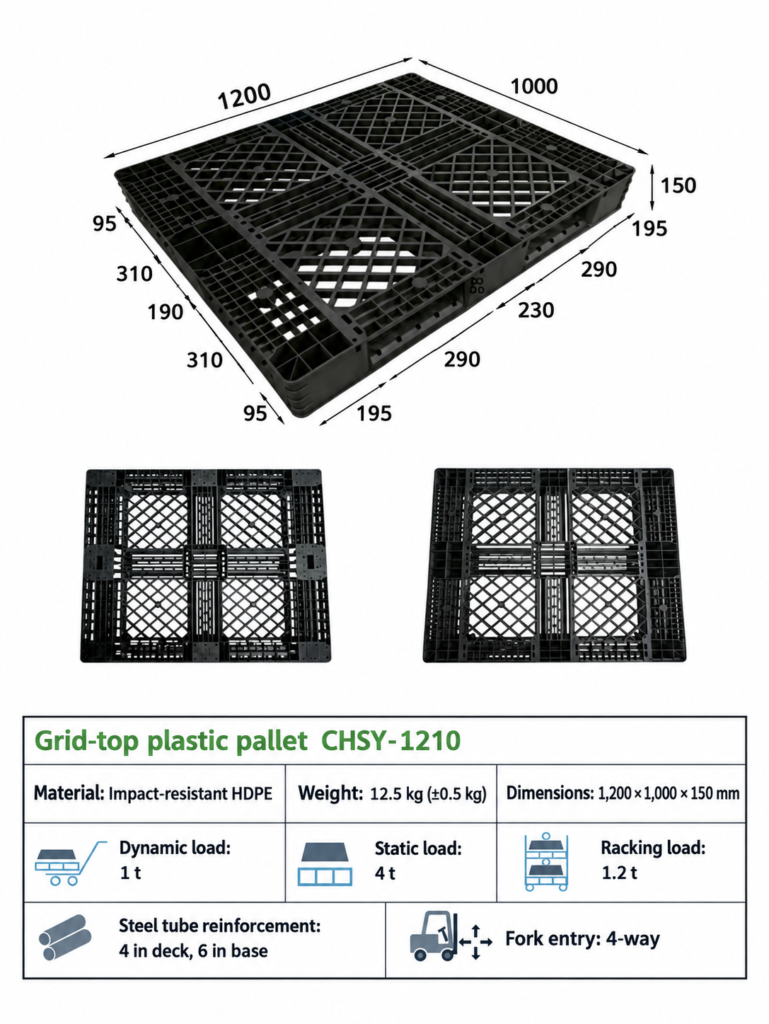
The supplied specifications for the CHSY-1210 Three-Runner Solid Deck pallet state a static load of 5,000 kg, a dynamic load of 1,500 kg and a racking load of 1,200 kg. This gives buyers three separate figures to assess for floor storage, handling and racking.
2. A ventilated-deck option with a stated racking capacity of up to 1,500 kg
For the CHSY-1210 Three-Runner Ventilated Grid Deck pallet, the supplied product information states a racking load of up to 1,500 kg. Confirm the static and dynamic ratings, beam arrangement and load-distribution conditions in the latest model datasheet before specifying it.
3. HDPE material for repeated handling
The company information states that its pallet range is manufactured from impact-resistant HDPE. For a particular application, buyers should also confirm the selected model’s temperature range, chemical compatibility and performance data.
4. Recyclable pallet options
The supplied information describes the range as recyclable. For purchasing policies that include recycled-content or end-of-life targets, ask which material is used in the model, whether recycled content is present, and what take-back or local recycling arrangements are available.
5. Options for different warehouse and logistics applications
The company identifies warehousing, logistics, e-commerce, food and drink, pharmaceuticals and cold-chain operations among its application areas. Suitability for a regulated or hygiene-sensitive environment must be confirmed for the specific pallet model and any required declarations or testing.
6. Product selection based on the actual load and handling method
When requesting a quotation, provide the pallet footprint, maximum gross load, whether the goods are evenly distributed, the handling equipment, stacking arrangement and whether the pallet will sit on racking. This allows the supplier to recommend an appropriate model rather than relying on the highest static-load figure.
Need a pallet specification or quotation?
Contact Qingdao Chenhuitong Plastics Co., Ltd. through the company website or sales email with your load, pallet dimensions and intended use. Ask for the latest datasheet and the supporting load-test conditions for any model intended for racking.
Explore More Success Stories

Inside CeMAT ASIA 2026: A
Case Studies Inside CeMAT ASIA 2026: A Plastic Pallet Maker’s Notes on Where Warehousing Is Heading A Chinese plastic pallet.....
Read Case Study →
Are Plastic Pallets Suitable for
Blog Are Plastic Pallets Suitable for Industrial and Logistics Use Explore plastic pallet sizes, types and benefits for logistics, food,.....
Read Case Study →
Are plastic pallets recyclable and
Blog Are plastic pallets recyclable and sustainable? Chenhuitong gives you the answer. Plastic pallets are widely used for storing, handling.....
Read Case Study →
Why use plastic pallets?Their role
Blog Why use plastic pallets?Their role in storage transport and everyday handling. Plastic pallets are widely used for storing, handling.....
Read Case Study →Frequently Asked Questions About Plastic Pallets
Can a plastic pallet carry 1,000 kg?
Yes, many industrial plastic pallets are designed for loads of 1,000 kg or more in at least one handling condition. The important question is whether the exact model is rated for 1,000 kg dynamically, statically or on racking.
Are all heavy-duty plastic pallets suitable for racking?
No. Racking places different stresses on a pallet from floor storage or forklift movement. Check the model-specific racking rating, reinforcement and permitted beam-support arrangement.
Are recycled plastic pallets strong enough for industrial use?
Some are. Strength depends on the formulation, manufacturing controls, pallet design and intended service conditions. Choose on the basis of verified ratings and suitable test evidence, not the word “recycled” alone.
Does static load capacity tell me what a forklift can carry?
No. Static load is for a stationary pallet under defined support conditions. Use the dynamic rating when assessing forklift or pallet-truck movement, and the racking rating for supported storage on beams.
What standard is relevant to testing plastic pallet load capacity?
ISO 8611-1:2025 sets out test methods for flat pallets, while ISO 8611-2:2025 sets out performance requirements and selection of tests. Ask whether the specific pallet has relevant test data and whether the test configuration matches your intended use.
Ready to optimize your material
handling?
Tell us about your requirements and our engineering team will deliver a custom quote
with product recommendations within 24 hours.