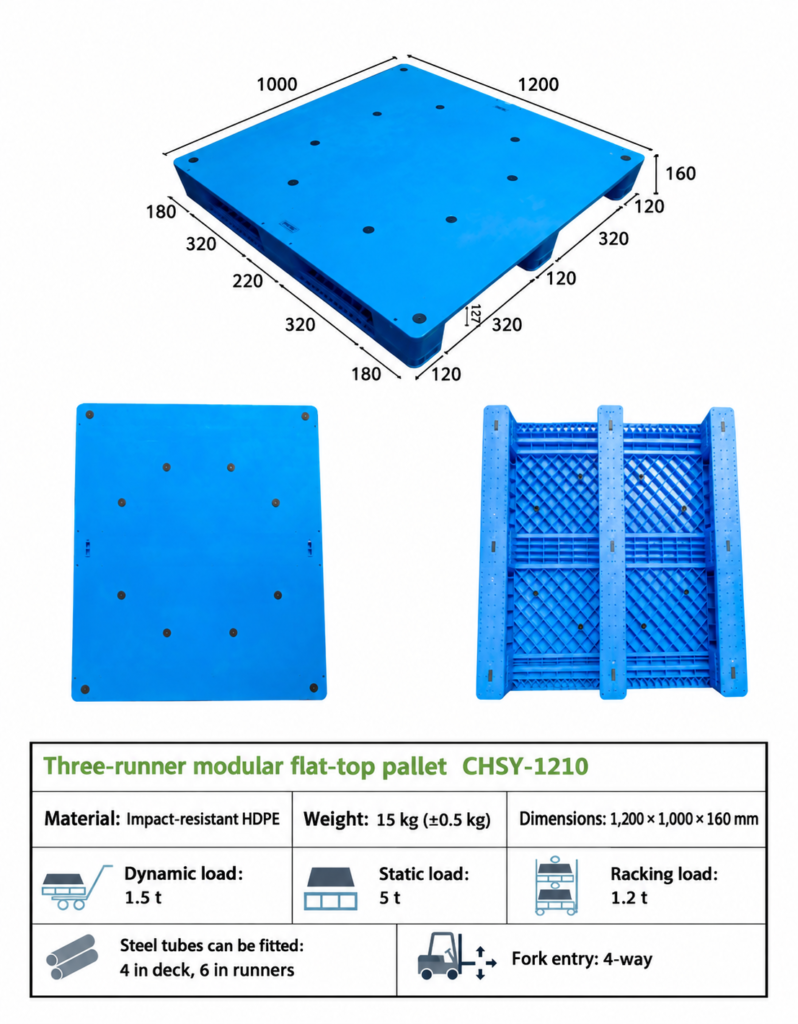
Yes. Plastic pallets made from HDPE or PP can be recycled and can support more sustainable logistics. Their value starts well before disposal: choosing a suitable design, keeping it in use and arranging an accepted recycling route can make better use of the material over its working life.
For a warehouse buyer, however, “recyclable” is only the beginning. Will the pallet suit your loads and equipment? Will it return after delivery? Who will accept it when it is damaged beyond use? The answers matter more than a green label.
Understand what the claims mean
Recyclable describes the potential to recover and reprocess material where suitable facilities accept it. Contamination, additives, inserts and local collection arrangements can affect the outcome. Recycled content describes the material used to make the pallet. A virgin plastic pallet may be recyclable; a recycled plastic pallet still needs an end-of-life route.
Sustainability covers the wider system, including production, transport, maintenance and disposal. Plastic does not automatically outperform wood in every application. Comparisons need an equivalent handling task and consistent lifecycle boundaries.
Choose HDPE or PP for the job
High-density polyethylene, or HDPE, combines toughness, moisture resistance and resistance to a range of chemicals. These properties can be useful in repeated handling and washing. For cold-chain applications, check the specific grade and finished pallet’s low-temperature performance rather than relying on the material name alone.
Polypropylene, or PP, generally offers useful stiffness and heat resistance. It can suit designs where structural support matters, but grade selection and modification affect impact performance, particularly at low temperatures.
Both are thermoplastics that can be reprocessed through suitable recycling routes. Their environmental value comes from appropriate use and recovery. Conventional HDPE and PP are not biodegradable materials and should never be released into the environment.
Use recycled material where it performs reliably
Verified recycled HDPE or PP can reduce the need for virgin resin. It is worth considering for general warehousing and industrial handling, provided the material meets the application’s requirements. Ask about its source, how the recycled content is established and how consistency is controlled. Colour alone is not evidence.
A higher recycled percentage is not useful if the pallet fails early. Heavy duty plastic pallets need performance checks under the intended support and loading conditions, regardless of whether the resin is virgin or recycled.
Design also matters. Clear resin identification, fewer unnecessary material combinations and separable metal reinforcement can help sorting. Confirm acceptance with a recycler. For food or pharmaceutical applications, assess the specific use and supporting documentation; virgin resin alone does not establish food-contact suitability.
Where sustainability gains arise in daily use
1. Keep pallets working and goods protected
Fewer premature replacements. Reusable plastic pallets selected for the load, environment and handling equipment can avoid failures caused by a poor specification. Record damage and completed trips to see whether the expected benefit is being achieved.
Less product damage. A suitable deck, appropriate anti-slip features and compatibility with forklifts and conveyors can support stable handling. Protecting the goods is part of the assessment, alongside the material used in the pallet itself.
Practical cleaning. Washable surfaces can support reuse, but cleaning consumes water, energy and chemicals. Set the cleaning regime according to contamination risk and inspect for cracks, distortion and areas that cannot be cleaned effectively.
Efficient empty returns. Nestable plastic pallets can reduce the space occupied on return journeys. Check that the chosen design also suits your loads, racking and conveyors. A long detour to recover empty pallets still carries a transport burden.
2. Assess one route before making a wider claim
Consider a regular route between a factory and a regional distribution centre. First establish whether the pallets will return. Next check the loading, equipment and cleaning requirements. Then agree who will receive unusable pallets. This is an illustrative purchasing scenario, not a customer case study.
Track five things: pallets introduced, completed trips, damage and losses, empty-return arrangements, and the weight handed over for recycling. A useful comparison is one successfully completed trip under the same load and route conditions, rather than the purchase of one new pallet.
For a carbon comparison, include resin sourcing, manufacturing energy, washing, repairs, transport and end-of-life treatment in a consistent lifecycle assessment. Without that information, a universal carbon-saving percentage would be misleading.
3. Give end-of-life pallets a workable recycling route
Custom plastic pallets from Chenhuitong Plastics
Qingdao Chenhuitong Plastics Co., Ltd. is developing its upstream and downstream capabilities around plastic pallets, connecting material selection and formulation with product design, mould development, manufacturing and customer applications. Our focus extends beyond how a pallet looks on delivery to how it fits the customer’s handling system.
Materials and dedicated formulations. We select HDPE or PP and develop dedicated formulations around the customer’s industry and project requirements. This means balancing toughness, stiffness, temperature performance and processing consistency, while considering the implications for recycling.
Quality and handling safety. We bring load weight, support conditions, forklift handling and racking requirements into the specification discussion. Clearly defined load ratings help match heavy duty plastic pallets to the work they need to perform.
Environmental performance in use. Material efficiency, durability and recyclability inform product development. The aim is a pallet that remains useful in its intended application, rather than a higher recycled percentage alone. Recycling arrangements must reflect the facilities available where the pallet is used.
Industry-specific design and service. For logistics, food and beverage, pharmaceutical, automotive and cold-chain applications, we discuss dimensions, deck design, equipment compatibility and cleaning requirements as part of customisation and product selection.
Looking for a plastic pallet manufacturer for a reusable handling project? Send us your load weight, pallet dimensions, operating temperatures, racking or conveyor details and expected return route. Chenhuitong can then discuss suitable materials, structure and a dedicated formulation with you, making sustainability part of the everyday handling decision.