
Are Plastic Pallets Suitable for Industrial and Logistics Use
Explore plastic pallet sizes, types and benefits for logistics, food, pharma and retail. Learn how to choose materials, load ratings and bespoke options.

Yes. Plastic pallets provide a stable base for unit loads, allowing cartons, bags, totes and components to move through receiving, storage, production and dispatch. With the right specification, the same pallet can work across forklift handling, conveyors and racking, reducing the need to break down loads or transfer goods onto another pallet.
Their value goes beyond carrying weight. Warehouse teams also need to know whether a pallet can be cleaned, how much space empties occupy, whether its base runs smoothly over a conveyor and how far it deflects during storage. Plastic pallets are particularly useful in frequent-use logistics, hygiene-sensitive operations and industrial systems with defined handling interfaces. The correct model still depends on the load, equipment and environment.
Practical advantages of plastic pallets in logistics
Fewer pallet changes. A consistent footprint and handling interface can help goods move from production to storage and dispatch on the same pallet. This requires acceptance by the receiving site and compatibility throughout the route. Matching length and width alone is not enough.
Straightforward cleaning and segregation. Suitable plastic surfaces can be washed or wiped, without timber splinters or exposed nails. Different colours can help distinguish raw-material, finished-goods and return areas. Cleaning performance depends on the design, cleaning procedure and drying arrangements; plastic is not inherently sterile.
More consistent equipment interfaces. Injection moulding allows control over the shape and position of key features. In automated warehouses, consistent runners, fork openings and flatness can help prevent interruptions caused by incompatible interfaces. The benefit should be confirmed in trials on the actual equipment.
Compact storage of empty pallets. Nine-leg nestable plastic pallets fit into one another when empty, making them useful for suitable retail delivery, export and return routes. Three-runner and six-runner designs prioritise different support arrangements and do not generally nest in the same way.
A practical option for managed reuse. Durable pallets make most sense when they can be recovered and damaged units can be sorted promptly. HDPE and PP pallets can enter suitable recycling streams where material identity, contamination levels and local acceptance allow. Recyclable plastic pallets are not necessarily recycled after every service life.
Why plastic pallets are widely used in logistics
A pallet connects several parts of an operation. Its top deck supports the goods; its underside meets handling equipment; the whole unit must tolerate the route’s cleaning, temperature and return conditions. A single footprint can be supplied with an open deck, solid deck, nestable base or rackable construction. Buyers can therefore select for the route rather than impose one design on every task.
For a distribution centre serving shops, return logistics and repeated handling may dominate the decision. In an automated store, dimensional tolerances and loaded deflection may matter more. Between a food production area and its warehouse, cleanability and segregation can take priority. This flexibility helps explain the broad use of plastic pallets.
Export is another application. All-plastic pallets fall outside the raw-wood packaging scope of ISPM 15, so the standard’s wood-treatment and marking requirements do not apply to the pallet itself. Any accompanying wooden dunnage needs separate assessment, and destination cleanliness requirements still need checking.
Compare cost per completed trip rather than purchase price alone. Add purchase, cleaning, return transport, repair and loss costs, subtract any realisable residual value, then divide by the number of completed trips. A one-way export shipment and a daily internal loop need different assumptions.
Plastic pallet sizes and types for different industries
The dimensions below are length × width in mm. They are common starting points, not mandatory sizes for each industry. The 1200 × 800 mm footprint is common in European logistics; 1200 × 1000 mm is common in UK and industrial operations. ISO 6780 covers principal dimensions and tolerances. A familiar footprint does not establish load capacity or equipment compatibility.
| Industry or operation | Typical footprints | Types and practical advantages |
|---|---|---|
|
Warehousing and third-party logistics |
1200 × 1000/ 1200 × 800 |
Three-runner rackable or open-deck designs for handling and storage; check support direction. |
|
Food and drink |
1200 × 800/ 1200 × 1000 |
Solid-deck hygienic or cleanable open-deck designs; assess racking loads separately for heavy drinks loads. |
|
Pharmaceutical supply chains |
1200 × 800/ 1200 × 1000 |
Closed-surface hygienic designs for inspection and identification; validate site cleaning procedures. |
|
E-commerce and retail |
1200 × 1000/ 1200 × 800/ 800 × 600 |
Full-size pallets for consolidation; half pallets on suitable delivery routes; nestable designs for returns. |
|
Cold stores and frozen distribution |
1200 × 1000/ 1200 × 800 |
HDPE models validated for the specified cold conditions; check impact and slip performance. |
|
Automotive and manufacturing |
1200 × 1000/ 1200 × 800 |
Heavy duty plastic pallets or bespoke support designs for concentrated component loads. |
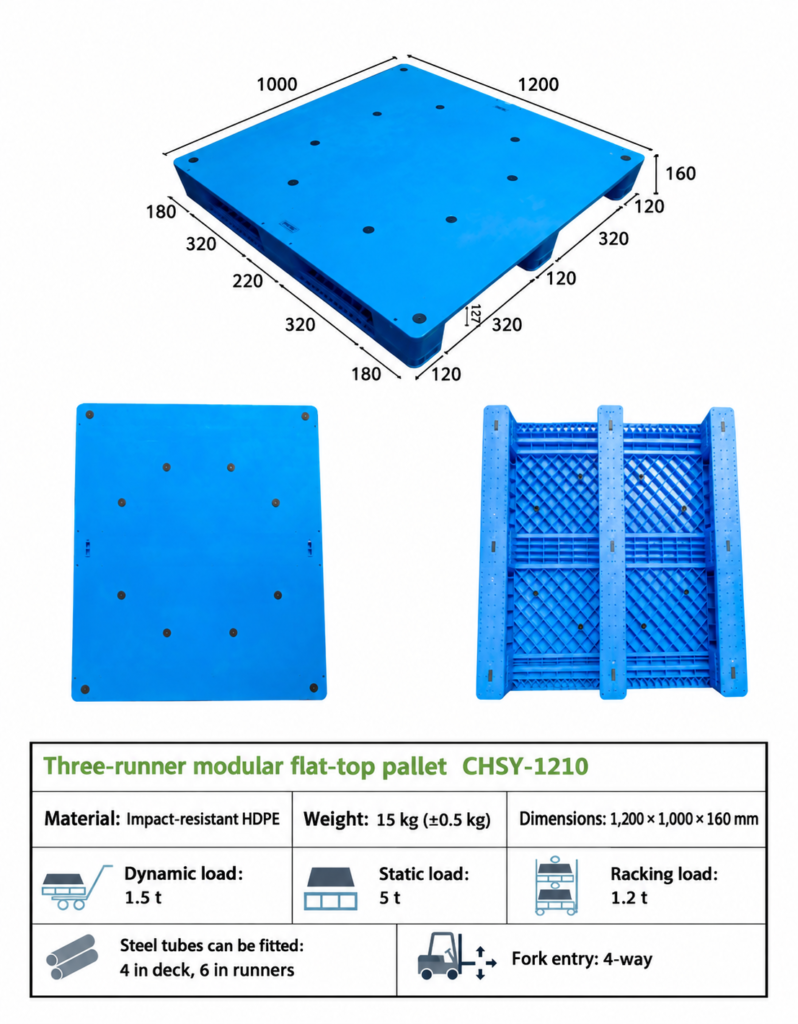
Two 1200 × 1000 mm plastic pallets can behave very differently. A nine-leg pallet for economical empty returns is not equivalent to a reinforced rackable pallet. Overall height, tare weight, fork clearance, runner width and reinforcement must be checked against the model drawing. Established pharmaceutical pallet ranges include both main footprints above, but individual sites may require different constructions.
What food pharma and e-commerce buyers should check
Food and drink. Bagged ingredients need sufficient deck support to prevent packaging sagging into large openings. Bottled or canned drinks call for careful assessment of deflection during prolonged racking. Solid decks offer accessible wiping surfaces; open decks can aid drainage and ventilation. Choose around packaging and cleaning methods. Where direct food contact is intended, verify documentation for the material and finished article under the intended contact conditions. Virgin HDPE alone is not proof of suitability.
Pharmaceutical operations. Priorities include verifiable cleaning, visible pallet condition and controlled movement between areas. A closed surface does not necessarily mean every internal cavity is sealed. Inspect joints, places where water can collect and the procedure for withdrawing damaged units. A hygienic pallet supports the site’s hygiene system; it does not replace it.
E-commerce and retail. Loads may move from full-pallet storage into split-case picking. Check support for the smallest cartons, mixed-load stability, stretch-wrap retention and space for empties. An 800 × 600 mm half pallet suits routes that accept it; it is not a direct substitute for the warehouse’s full-size pallet.
Cold chain and industrial manufacturing. Validate impact and slip performance at the actual cold-store temperature. For concentrated loads such as automotive components, design around the contact points rather than average load weight alone. Electronics operations requiring electrostatic control must specify and test the necessary resistance range. Ordinary plastic pallets should not be assumed to provide that protection.
European Pallet Dimensions and Technical Standards
There is no single footprint that suits every European supply chain. The 1,200 × 800 mm and 1,200 × 1,000 mm formats are both widely used, but the correct size depends on the warehouse, sector, racking, handling equipment and pallet-pooling arrangement. Matching the footprint alone does not make a plastic pallet interchangeable with a licensed EPAL pallet or a proprietary pool pallet.
Load ratings: use documented test conditions
When evaluating a pallet, ask how its load capacity was determined and whether the published rating matches the way the pallet will be used. ISO 8611-1:2025 sets out test methods for new flat pallets; ISO 8611-2:2025 covers performance requirements and selection of tests; and ISO 8611-3:2011 addresses the determination of maximum working loads. ISO 6780:2003 specifies principal dimensions and tolerances for flat pallets made from any material. These references help buyers frame a technical specification, but a reference to a standard alone is not proof that a particular model has passed the relevant tests.
Ask the supplier for the model-specific technical datasheet and, where relevant, test reports. The documents should make clear the load case, support arrangement, load distribution, pallet orientation and any temperature or handling limits. For racking applications, confirm the pallet and rack combination with the racking or system supplier before use.
Export requirements for wooden pallets
For international movements, wooden packaging may be subject to ISPM 15 phytosanitary requirements depending on the origin, destination and route. Buyers should check the current rules for the shipment rather than assume that every wooden pallet is treated in the same way. A pallet made entirely from plastic is not wood packaging material covered by ISPM 15; composite designs containing solid wood components need to be assessed separately.
Hygiene and regulated applications
For food, pharmaceutical or other controlled environments, ask for the material declaration, traceability information, cleaning guidance and any application-specific compliance evidence required by the site. HDPE construction alone does not establish food-contact suitability, sterility or compliance with every regulatory requirement.
ISO 8611-1:2025 | ISO 8611-2:2025 | ISO 8611-3:2011 | ISO 6780:2003 | UK wood packaging guidance
Understanding pallet types and load ratings
Nine-leg nestable plastic pallets suit routes where empty volume matters. Three-runner plastic pallets are often selected for conveyors and racking. Six-runner pallets offer a different base support layout. Double-deck designs can suit particular heavy-duty tasks, but not all work with hand pallet trucks. Solid deck and open deck describe the upper surface; rackable and nestable describe functions. These terms are not interchangeable.When comparing heavy duty plastic pallets, ask for three separate ratings and their conditions.
- Static load concerns a stationary pallet under specified support conditions, commonly full support on a level floor. It does not establish rack capacity.
- Dynamic load concerns handling under specified conditions, including the support provided by forks or a pallet truck.
- Racking load concerns the specified span, orientation and support arrangement. Load distribution, temperature, storage duration and allowable deflection all matter.
A 1000 kg consignment does not become suitable for beam racking simply because its pallet has a quoted dynamic load of 1500 kg. Support changes when the pallet enters the rack. Bags, drums and footed containers also distribute weight differently. Ask for evidence covering the intended conditions and validate the design in the operation.
Choosing between HDPE and PP plastic pallets
HDPE is commonly considered where toughness and low-temperature impact performance matter. PP is often considered for its stiffness and other properties in suitable industrial applications. Neither material name is a complete specification: resin grade, formulation, construction, temperature and loading together determine performance.
For prolonged racking, examine loaded deflection. For freezer work, validate cold impact resistance. For cleaning, check compatibility with the chemicals, temperature and repeated cycles involved. Virgin and recycled materials should also be assessed by source, consistency and suitability for the intended use, not price alone. A dedicated formulation should meet a defined operating need consistently; adding more ingredients is not a measure of quality.
Six checks before placing an order
- Load. Record packaging dimensions, total weight, uneven loading and actual contact points.
- Equipment. Confirm forklift, hand pallet truck, roller or chain conveyor and robotic interfaces.
- Racking. Provide support direction, span, beam or rail arrangement, storage time and deflection limits.
- Environment. Specify minimum and maximum temperatures, washing methods, outdoor exposure and site fire-safety requirements.
- Route. Confirm the receiver’s accepted footprint, empty returns and arrangements for lost or damaged pallets.
- Validation. Agree drawings, test conditions, loaded site trials and batch acceptance requirements.
Put a sample through the whole route: loading, fork entry, conveying, storage, unloading, cleaning and return. Record snagging, slipping, deflection and damage. This provides a more useful buying basis than comparing headline load figures alone.
Bespoke pallets from ChenHuiTong Plastics
Qingdao Chenhuitong Plastics Co., Ltd. provides bespoke plastic pallet services for multiple logistics businesses. We continue to develop our upstream and downstream capabilities across the pallet supply chain, connecting material selection and formulation with product design, tooling, manufacture and delivery support. For buyers, the purpose is practical: requirements identified in the warehouse can be followed through into the product specification.
Materials and dedicated formulations. We work with HDPE and PP and develop project-specific formulations around the required load, impact behaviour, temperature and operating conditions.
Design around the handling route. Dimensions, deck layout, fork openings, runners, anti-slip features and reinforcement can be considered alongside the customer’s packaging, equipment and racking.
Quality and safety defined for the project. Our specification discussions focus on dimensional consistency, suitable loads and operating limits. Testing, acceptance criteria and required quality documentation should be agreed in the project’s technical specification.
Environmental considerations tied to use. We consider repeated use, material identification and end-of-life recovery conditions. A plastic or recycled-material label alone does not establish the environmental outcome of a route.
Application-focused support. We work with customers through requirement discussions, sample evaluation and feedback from use. Tooling, formulation, testing and delivery arrangements depend on the agreed scope of the project.
Looking for a plastic pallet manufacturer for an industrial or logistics project? Send Chenhuitong your load dimensions and weight, preferred pallet size, racking drawings, operating temperature, quantity and destination. These details provide a sound starting point for discussing heavy duty plastic pallets, rackable models or a bespoke design for your operation.
Explore More Success Stories

Inside CeMAT ASIA 2026: A
Case Studies Inside CeMAT ASIA 2026: A Plastic Pallet Maker’s Notes on Where Warehousing Is Heading A Chinese plastic pallet.....
Read Case Study →Are Plastic Pallets Suitable for
Blog Are Plastic Pallets Suitable for Industrial and Logistics Use Explore plastic pallet sizes, types and benefits for logistics, food,.....
Read Case Study →
Are plastic pallets recyclable and
Blog Are plastic pallets recyclable and sustainable? Chenhuitong gives you the answer. Plastic pallets are widely used for storing, handling.....
Read Case Study →
Why use plastic pallets?Their role
Blog Why use plastic pallets?Their role in storage transport and everyday handling. Plastic pallets are widely used for storing, handling.....
Read Case Study →Frequently Asked Questions About Plastic Pallets
Can all plastic pallets be used in racking?
No. A nestable export pallet may lack the support arrangement required. Choose a model explicitly suitable for the rack and check the test conditions.
Is a Euro-size plastic pallet an EPAL pallet?
No. The 1200 × 800 mm description identifies a footprint. Membership of an exchange system and any relevant licensing must be established separately.
Are plastic pallets always cheaper than wooden pallets?
No. The answer depends on purchase cost, completed trips, cleaning, returns and losses. Frequent closed-loop use is a good reason to compare whole-life costs.
Does recyclable mean made from recycled plastic?
No. Recyclable describes a possible end-of-life route; recycled describes the source of production material. A pallet may meet one description or both.
Ready to optimize your material handling?
Tell us about your requirements and our engineering team will deliver a custom quote
with product recommendations within 24 hours.