
Why use plastic pallets?Their role in storage transport and everyday handling.
Plastic pallets are widely used for storing, handling and transporting goods across modern supply chains. For businesses looking to manage operating costs, simplify maintenance and improve handling efficiency, they can offer a practical alternative to traditional wooden pallets.

Plastic pallets provide a base for storing, handling and transporting goods. They turn cartons, sacks or reusable containers into a unit load that a forklift or pallet truck can move together. They also form the interface between the goods and the equipment supporting them.
Businesses rarely choose a pallet simply because it is plastic. They need it to survive a wash cycle, support cartons without damaging them, travel reliably through a conveyor system or take up less space on the return journey. The right material and design help solve those problems.
Why businesses choose plastic pallets
Moulded plastic pallets have no wooden splinters or nails, resist moisture and can be designed with closed decks, open decks, anti-slip features or reinforcement. These characteristics can be useful where pallets circulate frequently, need cleaning or must work with handling equipment.
They are not automatically the lowest-cost option on every route. For one-way shipments with little prospect of recovery, purchase price, weight and disposal at the destination deserve attention. In a controlled return loop, durability, cleaning costs and cost per completed trip may matter more. That distinction is a useful starting point for choosing plastic pallets for warehouse storage and distribution.
What are plastic pallets used for
- Moving goods as a unit. Once goods are stacked and secured, an entire load can be moved without handling every package separately. The result depends on sound stacking, suitable packaging and correct equipment operation.
- Supporting the load. A suitable deck supports cartons, sacks or containers and limits unsupported areas. Keeping goods off the floor is useful, although a pallet cannot replace waterproof packaging or good housekeeping.
- Connecting handling equipment. Pallet dimensions, fork openings and the underside must suit the forklifts, pallet trucks, racking and conveyors in use. Four-way entry does not mean compatibility with every pallet truck; fork clearance and wheel access still matter.
- Organising repeat use. A design suitable for washing can fit into an established cleaning routine. Colours, identification numbers and optional tracking tags can help separate areas and manage pallet movements. Tracking requires compatible readers and management systems.
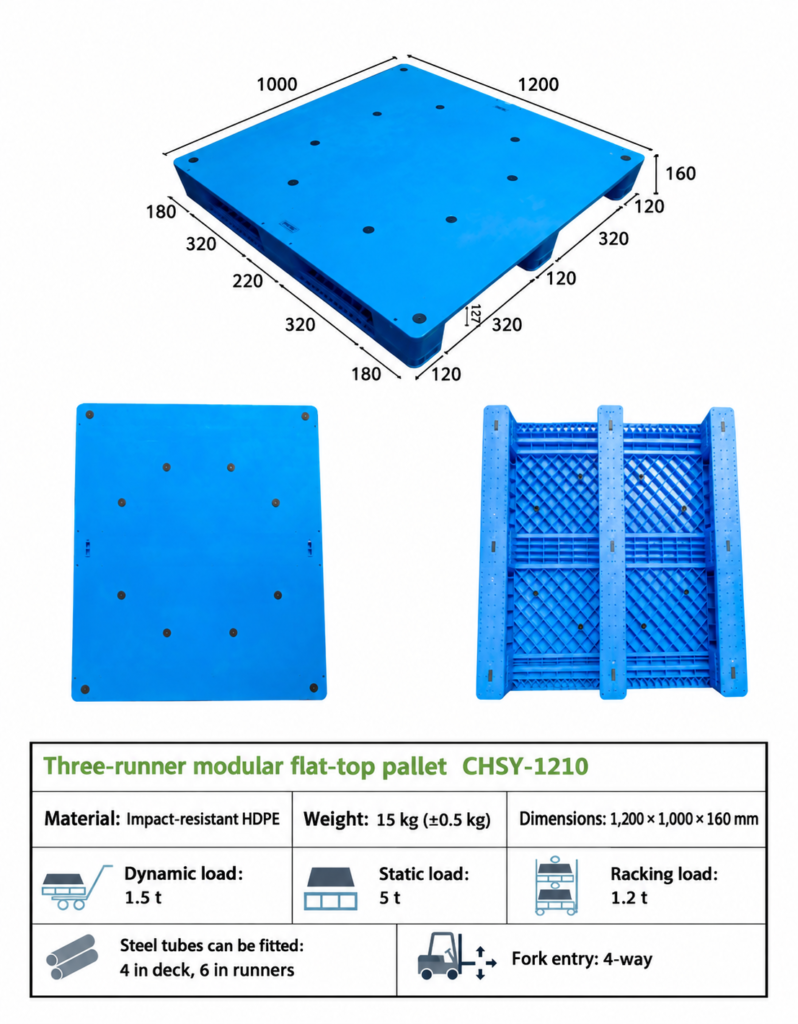
Benefits across warehouse food and pharmaceutical operations
Warehousing logistics and automated systems
A warehouse needs a pallet that performs consistently under load. Consistent dimensions and a suitable underside can help reduce transfer problems caused by differences between pallets.
- Floor storage: choose a deck suited to the packaging and check access for both forklifts and pallet trucks.
- Beam racking: specify rackable plastic pallets validated for the actual support arrangement, span, deflection limits and storage duration.
- Automated handling: assess dimensional tolerances, contact surfaces, sensor detection and the loaded pallet together. Matching the nominal length and width is not enough.
Heavy duty plastic pallets can suit demanding loads, but “heavy duty” is not a universal load rating. Static, dynamic and racking loads must be checked separately. A high static rating does not establish suitability for racking.
Food and beverage production
Drinks cases, sacks of ingredients and packaged food do not all need the same support. A closed deck can support smaller packs and reduce the entry of debris into some internal areas. An open design may offer better drainage. The choice should follow the packaging and cleaning process.
- Practical benefits: no wooden splinters or nails, and designs that can be incorporated into a cleaning routine.
- What to check: joints, recesses, drainage, drying and compatibility with cleaning chemicals.
- Where to be careful: use in a food warehouse is different from direct food contact. For direct contact, verify the documentation required for the intended application and destination market. Virgin resin alone is not proof of suitability.
For buyers researching hygienic plastic pallets for food processing, the useful question is how the pallet will be cleaned and inspected in their own operation.
Pharmaceuticals and medical supplies
Pharmaceutical warehouses need to control contamination and maintain clear rules between operating areas. Plastic pallets with inspectable surfaces and suitable cleaning characteristics can support the storage and distribution of packaged medicines and medical supplies.
- Practical benefits: colours and identification numbers can assist segregation; suitable flat decks support smaller cartons; surfaces can be inspected after cleaning.
- What to check: material and design compatibility with the site's cleaning and drying procedures, with validation where required.
- Where to be careful: a pallet does not make a warehouse GMP-compliant. Sterility or compatibility with a sterilisation process must not be assumed without validation. Pharmaceutical plastic pallets should be selected as part of the site's handling and hygiene procedures.
Benefits across cold chain manufacturing retail and export
Cold chain and frozen storage
Cold stores expose pallets to low temperatures, impacts and condensation. Moisture resistance is useful, but impact performance at low temperatures still depends on the resin grade, formulation and finished design.
- Practical benefits: plastic does not absorb moisture and swell like moisture-absorbing materials; deck designs can be selected around packaging and drainage needs.
- What to check: minimum temperature, exposure time and handling conditions. Validate load and impact performance at the relevant temperature, and assess slip control where ice or condensation can occur.
Automotive components and industrial manufacturing
A regular loop within a factory or between suppliers makes reusable pallets easier to manage. Pallets sized around the containers can reduce the need to change bases between workstations.
- Practical benefits: designs can accommodate containers, locating features and anti-slip requirements. Suitable heavy duty plastic pallets can carry heavier components where the application has been validated.
- What to check: minimum temperature, exposure time and handling conditions. Validate load and impact performance at the relevant temperature, and assess slip control where ice or condensation can occur.
E-commerce retail and distribution centres
Mixed cartons, changing orders and frequent replenishment put the focus on deck support and handling consistency. A suitable deck helps avoid leaving smaller packs unsupported; a consistent pallet footprint helps organise storage and loading.
- Practical benefits: some nestable plastic pallets reduce space occupied by empty pallets. Identification can help manage store returns and distribution centre stock.
- What to check: support for small packs, load restraint and the empty-pallet return route. Nestability and racking suitability are separate requirements.
Export and cross border transport
All-plastic pallets fall outside the wood packaging scope of ISPM 15, so they do not require the wood treatment or fumigation associated with that standard.This removes a wood packaging treatment step; it does not exempt the shipment from inspection.
- Practical benefits: lightweight plastic pallets for export can be selected around one-way transport, packaging dimensions and the receiving site's equipment.
- What to check: whether the receiver accepts plastic pallets and whether a pallet exchange scheme applies. Solid wood dunnage or crates used with the shipment require their own checks.
- Cost consideration: reducing pallet weight must not compromise support for concentrated loads, repeated transfers or extended storage.
Choosing materials and assessing the cost of reuse
HDPE or PP plastic pallets
Both high-density polyethylene (HDPE) and polypropylene (PP) are used to manufacture plastic pallets. Start with temperature, loading, impact and cleaning conditions, then assess the finished design.
HDPE is a candidate where toughness and low-temperature use matter. PP is a candidate where stiffness is a priority. These are starting points, not fixed rules: PP grades vary considerably, and copolymer selection or modification can change impact performance.The actual grade, formulation and finished-pallet validation should guide the decision.
An application-specific formulation allows performance priorities to be considered together. Long-term racking and frequent impacts place different demands on a pallet. Improving one characteristic may affect weight, cost or recycling arrangements. Formulation, structure, tooling and processing need to be considered as a package.
What recyclable plastic pallets offer
Recyclable plastic pallets provide an opportunity to recover material at the end of service, but local collection and processing must exist. Ask about polymer identification, contamination limits and the removal of steel reinforcement or other components.
Environmental performance also depends on completed trips, empty return distances, washing and loss rates. Material type alone does not establish a lower carbon footprint. Reducing avoidable damage and organising recovery are practical first steps towards making reuse work.
Compare pallets on the same route using: cost per trip = (purchase cost + cleaning and maintenance + empty returns + end-of-life costs − residual value) ÷ completed trips. Record attributable product damage separately if it is included in a wider comparison. Estimated savings should not be presented as measured results.
Six details to send your plastic pallet manufacturer
- Goods: dimensions, total weight, packaging and load distribution.
- Storage: floor stacking or racking, support span and storage duration.
- Equipment: forklifts, pallet trucks, conveyors and automated interfaces.
- Environment: minimum and maximum temperatures, moisture and cleaning methods.
- Route: one-way export or repeat circulation, destination and recovery arrangements.
- Validation: the loaded handling, equipment compatibility and cleaning checks required before approval.
Asking only “How much can it carry?” leaves too much unanswered. These details give a plastic pallet manufacturer a sound basis for recommending a usable specification.
Plastic pallet manufacturing at Chenhuitong
How Qingdao Chenhuitong Plastics supports your project
Qingdao Chenhuitong Plastics manufactures plastic pallets and offers custom solutions for different industries. Our approach brings material selection, quality, safety, environmental considerations and service into the same specification discussion.
- HDPE and PP material options. We can discuss material choices around your operating temperature, toughness, stiffness and cost requirements, rather than choosing a resin name in isolation.
- Application-specific formulations. We can develop a dedicated formulation for the agreed load, temperature and circulation requirements, alongside the pallet structure. The validation plan should reflect those priorities; a custom formulation is not a substitute for testing.
- Clear quality and safety requirements. Dimensions, deck design, fork access and loading conditions belong in the project specification. Agreed acceptance criteria give sample assessment and subsequent supply a common reference point.
- Designs matched to the industry. Food and pharmaceutical projects place emphasis on cleaning and pack support. Warehouse projects require attention to equipment and racking interfaces. Cold chain applications need low-temperature assessment, while export orders also depend on weight, destination requirements and transport costs.
- Environmental considerations across the service life. We can discuss reuse, material choices and the feasibility of recycling after service. The aim is to avoid adding unnecessary material or cost in pursuit of a single specification figure.
- A clear route through customisation. Connecting requirements, sample assessment, order specifications and user feedback helps reduce selection errors. Inspection, documentation and service scope are agreed for the individual project.
Choosing plastic pallets for a warehouse, production line or export order? Send Chenhuitong your load dimensions, weight, operating temperature, equipment details and estimated quantity. We can discuss the material, structure and formulation around the way your pallets will actually be used.
Explore More Success Stories

Inside CeMAT ASIA 2026: A
Case Studies Inside CeMAT ASIA 2026: A Plastic Pallet Maker’s Notes on Where Warehousing Is Heading A Chinese plastic pallet.....
Read Case Study →
Are Plastic Pallets Suitable for
Blog Are Plastic Pallets Suitable for Industrial and Logistics Use Explore plastic pallet sizes, types and benefits for logistics, food,.....
Read Case Study →
Are plastic pallets recyclable and
Blog Are plastic pallets recyclable and sustainable? Chenhuitong gives you the answer. Plastic pallets are widely used for storing, handling.....
Read Case Study →Why use plastic pallets?Their role
Blog Why use plastic pallets?Their role in storage transport and everyday handling. Plastic pallets are widely used for storing, handling.....
Read Case Study →Frequently Asked Questions About Plastic Pallets
Can every plastic pallet be used in racking?
No. The model must suit the racking and support conditions. A static load figure is not a racking rating, and deformation during extended storage also matters.
Are plastic pallets suitable for food operations?
Suitable materials and designs can support food storage and handling. Direct food contact requires a separate assessment of the intended use and relevant documentation.
Are recycled plastic pallets necessarily less durable?
No single label settles that question. Feedstock quality, batch control, formulation and design all influence performance. Assess the finished pallet under the specified conditions.
Why not buy the cheapest pallet?
It may be the right choice if it suits the route. Frequent damage, equipment incompatibility or expensive empty returns can change the overall cost.
Ready to optimize your material
handling?
Tell us about your requirements and our engineering team will deliver a custom quote
with product recommendations within 24 hours.