
HDPE or PP Plastic Pallets: Which material is best and holds up?
HDPE or PP plastic pallets? We break down cold resistance, heat tolerance, racking creep and recyclability — with real-world guidance from plastic pallet manufacturers.

If you’ve sourced plastic pallets before, you’ve read the comparison tables a dozen times — HDPE handles cold, PP handles heat, both are recyclable. Sounds straightforward. But that doesn’t answer the questions you actually care about: which pallet won’t crack in your cold store by the second winter? Which one won’t sag under 800 kg of stock sitting on a rack for six months?
We manufacture both materials for customers across Europe, and we’ve seen the same sourcing mistakes happen over and over. This isn’t a materials science textbook. It’s the practical stuff you need to make the right call the first time.
What Are HDPE and PP, Anyway?
HDPE (High-Density Polyethylene) is a rigid, semi-crystalline thermoplastic. You interact with it every day — milk bottles, laundry detergent jugs, road safety barriers. Its defining trait is that it absorbs impact by flexing rather than snapping outright. As a pallet material, it’s the workhorse that gets whacked by forklifts at 4am every morning and keeps going.
PP (Polypropylene) is also semi-crystalline, but with a higher melting point and a stiffer molecular structure. You’ll find it in microwave food containers, living hinges on battery cases, and car bumpers. As a pallet, its advantages are lighter weight at the same load rating, and dimensional stability at elevated temperatures.
Neither material is universally better. But for your specific operating conditions, one of them is almost certainly the wrong choice.
The Comparisons That Actually Matter
Online tables love to quote density, tensile strength and melt temperature. The numbers below are the ones that matter on your warehouse floor:
| What You Actually Care About | HDPE Pallets | PP Pallets |
|---|---|---|
|
Low-temperature performance |
Excellent. Retains impact resistance down to -30°C to -40°C; glass transition around -120°C. It will never turn brittle in a standard cold store. |
Poor below -10°C. PP starts to embrittle around 0°C and will crack on impact in deep-freeze environments. |
|
Heat resistance |
Softens around 70–80°C. Fine for ambient warehouses, but keep away from hot-filling lines, sterilisation tunnels, or long spells on sun-baked tarmac. |
Withstands 110–120°C. The go-to choice for steam cleaning, hot process areas and pallet ovens. |
|
Impact resistance |
Excellent. HDPE absorbs forklift knocks, drops and rough handling through deformation. Rarely cracks — as long as it’s not frozen. |
Good at room temperature, but inferior to HDPE under sudden point loads. Higher stiffness = less give = more chipping or cracking on hard impact. |
|
Racking storage & long-term creep |
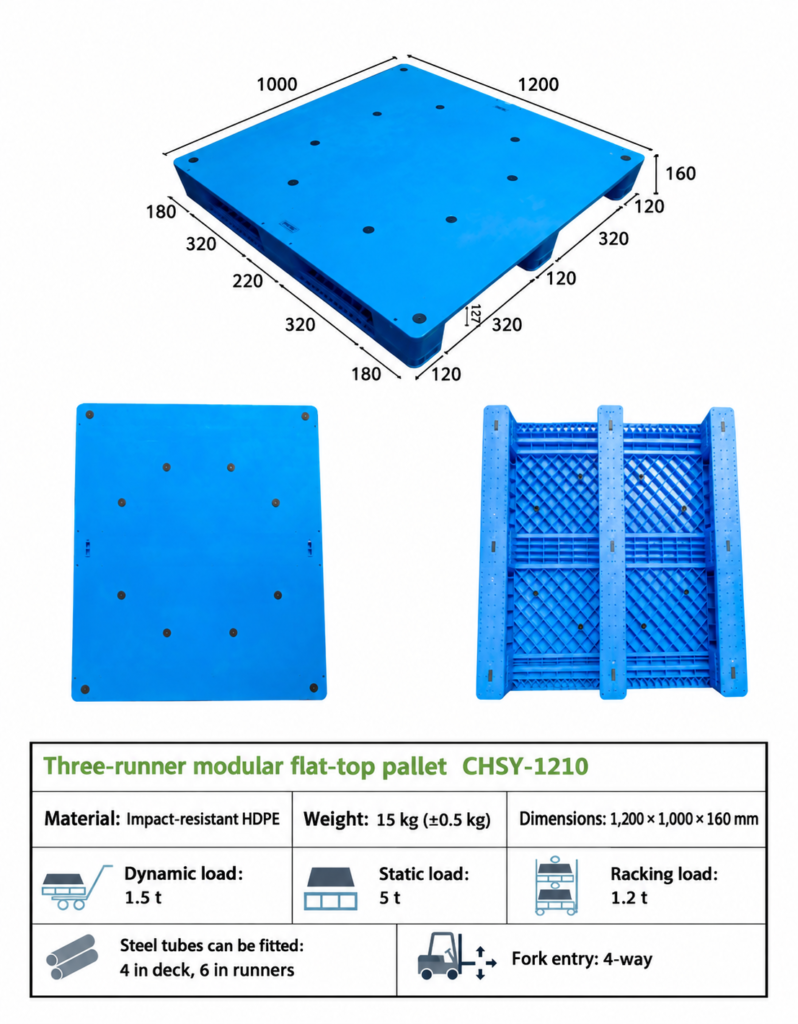
Notable creep — under sustained racking loads, HDPE slowly deforms over months. Heavy-duty rackable HDPE pallets must have steel tube reinforcement. |
Naturally stiffer, better creep resistance. Well-designed PP pallets handle 1,000–1,500 kg racked load without steel tubes; higher with reinforcement. |
|
Weight |
Higher density = heavier at the same dimensions. |
Lighter. A 1200×1000 mm PP pallet is roughly 1–2 kg lighter than the equivalent HDPE unit. |
|
Chemical resistance |
Broad-spectrum. Resists most acids, alkalis and solvents. The standard choice for drum storage and chemical distribution. |
Good acid/alkali resistance, but weaker against aromatic hydrocarbons and chlorinated solvents. Fine for pharma and food; not ideal for strong chemical spill scenarios. |
|
Food contact compliance |
Virgin material meets FDA and EU 10/2011 standards. Default choice for fresh produce, meat and dairy cold chains. |
Also food-grade, and its heat resistance makes it preferred in baking, ready-meal and dairy processing (where wash-down temperatures run high). |
When Are HDPE Pallets the Right Call?
Cold chain and frozen food logistics. This is HDPE’s home turf. Any cold store below -18°C — frozen vegetables, ice cream, seafood, pharma cold chain — should specify HDPE. We’ve seen customers try to save money with PP pallets in a -25°C warehouse. They replaced half the fleet within a year.
Beverage and bottled water distribution. The concentrated point loads of water jugs and case goods, the rough handling of LTL freight, outdoor yard storage through winter — HDPE shrugs it off.
Chemical and drum storage. Its broad chemical resistance means solvent spills won’t eat through the pallet surface, and caustic wash-downs won’t cause stress cracking.
Heavy transport and export freight. HDPE’s impact resistance gets pallets through container stuffing, side-unloading at destination ports, and the inevitable rough forklift handling across long supply chains. For heavy-duty plastic pallets carrying 1,000–2,000 kg dynamic load on international routes, steel-reinforced HDPE is the safe specification.
When Are PP Pallets the Better Choice?
Food plants with high-temperature wash-downs. Bakeries, ready-meal factories, dairy processing — any line where pallets pass through an 80°C+ wash tunnel. PP handles repeated hot water and steam cleaning; HDPE will warp over time.
Pharmaceutical and cleanroom environments. PP’s stiffness means a flat, dimensionally stable deck — critical for AGV systems and conveyor lines. The non-porous surface washes down to pharma-grade standards without harbouring bacteria in micro-cracks.
Automotive and component manufacturing. Gearbox parts, stampings, tote bins — operations need stiff, dimensionally consistent pallets. PP tolerates oil and hydraulic fluid commonly found in car plants.
Lightweight export and one-way shipping. PP is lighter, lowering sea freight per pallet. For short loops or export-only scenarios where pallets aren’t returned, lightweight recyclable plastic pallets made with regrind can work out cheaper overall.
Dense racking warehouses. If your storage model is beam racks at 1,000+ kg per level, PP’s creep resistance means less deck sag over a 5+ year service life. On racking, PP genuinely outlasts HDPE.
Recyclability — Don't Stop at the Marketing Line
HDPE and PP are recycling codes #2 and #5 respectively, and both are mechanically recyclable. But ‘recyclable’ and ‘actually recycled’ are two very different things.
Here’s what really happens:
Monomaterial pallets (no steel tubes, no mixed materials) are the highest-value feedstock for recyclers. If you’re buying a heavy-duty plastic pallet with internal steel reinforcement, the tubes have to be extracted before shredding — an extra processing cost that sometimes sends the whole pallet to landfill instead.
Europe has the most mature pallet recycling infrastructure, with manufacturers and pooling companies running established take-back schemes. Closed-loop models — pallets returned to the original manufacturer for regranulation — are where recyclable plastic pallets deliver genuine environmental value.
When you vet a supplier, ask one question: do you run your own regranulation line, or do you buy regrind from third parties? The answer tells you a lot about their quality consistency.
Three Sourcing Mistakes We See Repeatedly
- Comparing per-pallet price instead of cost-per-use. A cheap HDPE pallet that cracks in two years vs a more expensive one running eight years — the cost-per-use ratio flips completely. Always calculate over expected service life.
- Ignoring racking creep. A pallet passes its rack load test on day one. Sustained under 1,000 kg for six months, the HDPE deck starts to sag. Always ask: does the rated rack load include steel reinforcement? Does the supplier have long-term creep test data?
- Choosing material by product catalogue photos instead of operating environment. Supplying a warehouse in Portugal versus one in Sweden means wildly different temperature requirements. Portugal sees extremes from roughly -9.5°C to +47°C; Sweden from about -40°C to +38°C. Select by actual duty cycle, not by brochure imagery.
Quick Decision Checklist
Still not sure? A reputable plastic pallet manufacturer will ask about your load, environment and automation setup before quoting — not just send you a price.
- Will pallets be used below -10°C? → Choose HDPE
- Will they face 80°C+ temperatures or steam cleaning? → Choose PP
- Mainly racking, long-term static load? → Choose PP (or steel-reinforced HDPE)
- Main stress is impact and rough handling? → Choose HDPE
- Food-grade cold chain? → HDPE (PP if wash-down temperatures are high)
- Lightweight export, one-way use? → PP (regrind option available)
- Chemical spill risk? → Choose HDPE
About Qingdao Chenhui Tong Plastics Co., Ltd.
Qingdao Chenhui Tong Plastics Co., Ltd. is a professional plastic pallet manufacturer based in Qingdao, Shandong Province, part of the Henan Sitong Group. We produce both HDPE and PP pallets using injection moulding and blow moulding processes, covering grid-top, flat-top, EUR dimensions, rackable and heavy-duty plastic pallets across the full specification range.
Our core advantages for overseas customers:
- Quality control from resin to finished pallet. We run both virgin material and food-grade material lines, with full batch traceability. Every shipment undergoes load testing to ISO 8611 before dispatch.
- Safety-focused design. Four-way forklift and pallet truck compatibility on all pallets, chamfered edges, and non-slip deck options available on request.
- Environmental responsibility. Recyclable plastic pallets are central to our product range — regrind options for non-food applications, and closed-loop take-back programmes for long-term customers.
- Service beyond the product itself. We help customers select the right pallet specification for their racking system, automation line and container dimensions. Custom colours, branding and sizes are available at volume.
Whether your operation is frozen food cold chain or high-temperature food processing, we’ll specify the right material and configuration — and stand behind it for the full service life of the pallets.
Looking for heavy-duty plastic pallets or recyclable plastic pallets for a UK or European operation? Contact Qingdao Chenhui Tong Plastics Co., Ltd. to discuss your handling requirements and request current, model-specific specifications before placing an order.
Explore More Success Stories

Inside CeMAT ASIA 2026: A
Case Studies Inside CeMAT ASIA 2026: A Plastic Pallet Maker’s Notes on Where Warehousing Is Heading A Chinese plastic pallet.....
Read Case Study →
Are Plastic Pallets Suitable for
Blog Are Plastic Pallets Suitable for Industrial and Logistics Use Explore plastic pallet sizes, types and benefits for logistics, food,.....
Read Case Study →
Are plastic pallets recyclable and
Blog Are plastic pallets recyclable and sustainable? Chenhuitong gives you the answer. Plastic pallets are widely used for storing, handling.....
Read Case Study →
Why use plastic pallets?Their role
Blog Why use plastic pallets?Their role in storage transport and everyday handling. Plastic pallets are widely used for storing, handling.....
Read Case Study →Frequently Asked Questions About Plastic Pallets
Are plastic pallets stronger than wooden pallets?
Some heavy-duty plastic pallets are designed for demanding loads and repeated use, but performance depends on the exact model, support conditions and load distribution. Compare documented static, dynamic and racking ratings for the intended application rather than comparing materials in general.
Are recyclable plastic pallets a more sustainable option?
They can support reuse and material recovery, particularly in a managed returnable system. The environmental outcome depends on service life, transport, collection rates and the availability of a suitable recycling route. The term “recyclable” does not, by itself, mean that a pallet will actually be recycled.
Are plastic pallets suitable for food and pharmaceutical logistics?
They can be suitable where the pallet design, material and cleaning process meet the operation’s requirements. Buyers should confirm product-specific declarations and the regulatory or customer requirements that apply to the facility and supply chain.
What is the difference between static, dynamic and racking load capacity?
Static load capacity applies when a pallet is stationary under defined support conditions. Dynamic load capacity applies during handling, while racking load capacity applies when the pallet is supported by rack beams. These figures are meaningful only when the test conditions and load arrangement are understood. Follow the manufacturer’s instructions.
Which pallet standards should European buyers check?
For dimensions, ISO 6780:2003 may be relevant; for load and performance testing, consult the applicable parts of the ISO 8611 series. Ask the supplier which edition and tests were used and request evidence for the exact model and application. Also check any customer, sector, site or pallet-pool requirements that apply.
How do I choose a plastic pallet supplier?
Request a model-specific technical datasheet, load ratings and test conditions, material details, dimensions, environmental limits, quality documentation and guidance for the intended handling system. Where practicable, evaluate a sample under representative operating conditions before committing to a large order.
Ready to optimize your material
handling?
Tell us about your requirements and our engineering team will deliver a custom quote
with product recommendations within 24 hours.